Tuesday, April 18, 2017

Paleo File - Daeodon

(Daeodon and Amphicyon by BlueRhino Studios)

-----------------------------------------------------------------------------------------------------------------------------------------------------------------------
Grubbing around the plains of Oligocene North America, lived a chimeric beast of pig, bison, and dog-like qualities. This massive beast could go toe-to-toe with an American bison and tear it to shreds with its massive teeth and bone crushing jaws. This terrifying hell-pig, is the mighty, Daeodon!
-----------------------------------------------------------------------------------------------------------------------------------------------------------------------

(Pablo Lara)
-----------------------------------------------------------------------------------------------------------------------------------------------------------------------
The Oligocene was a time of transition. Animal forms were changing from the weird and wonderful experiments of the early Eocene and Paleocene, to the more familiar forms of the Neogene and Quaternary. There were many mammals with a strange mix of characteristics we see on our world’s modern inhabitants. There were long-legged running rhinoceros, which produced the largest mammal to walk on land, Paraceratherium, and there were strange dog-like animals with an appearance much like marsupials but completely unrelated, and of course, the entelodonts.
-----------------------------------------------------------------------------------------------------------------------------------------------------------------------
(Properly filled-out Daeodon reconstruction by Thuat (Tut))
-----------------------------------------------------------------------------------------------------------------------------------------------------------------------
Entelodonts were a group of large pig-like animals belonging order Artiodactyla. This group also holds whales, pigs, and hippos. These animals were rather chimeric in appearance. Most of them had Bison shaped bodies with tall neural spines that would have held muscle and fat in life. Daeodon was the largest of this group of animals. 
-----------------------------------------------------------------------------------------------------------------------------------------------------------------------
(Skeletal by bLAZZE92)
-----------------------------------------------------------------------------------------------------------------------------------------------------------------------
There are two species of Daeodon known; D. shoshonensis, and D. humerosum. Daeodon material was first discovered and described in the 1800s, by famed paleontologist Edward Drinker Cope and were uncovered in the John Day Formation of Oregon. Cope’s infamous academic rival, Othniel Charles Marsh, later uncovered more material. However, due to their rivalry and the scientific practices of the time, Marsh named his specimens Dinohyus hollandi and Ammodon leidyanum. These were found in the Agate Springs quarry of Nebraska.
-----------------------------------------------------------------------------------------------------------------------------------------------------------------------


-----------------------------------------------------------------------------------------------------------------------------------------------------------------------
Daeodon lived all across what is now the United States, but was not very abundant in the ecosystems it inhabited. This animal exhibited a large head; the skull could reach lengths of up to 3 feet, which held large teeth of varying shapes reminiscent of the maw of the modern Hippopotamus. Daeodon had blunt conical tusk-like canines at the front of its jaws and flat ridged chewing teeth at the back. This interesting dentition suggests the animal may have been an omnivore, shuffling through foliage and preying on small animals. 
-----------------------------------------------------------------------------------------------------------------------------------------------------------------------
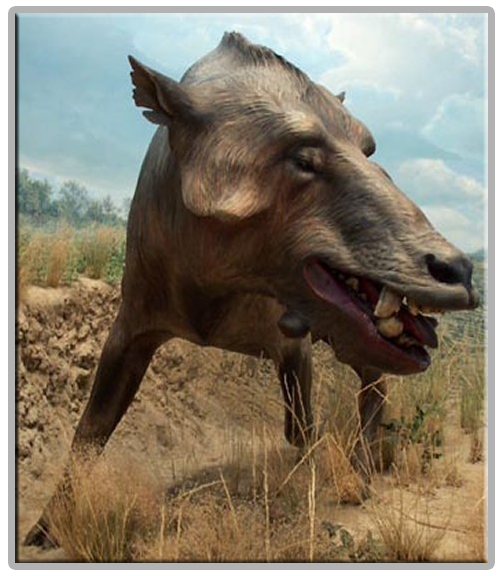
(Reconstruction at the Denver Museum of Nature and Science)

-----------------------------------------------------------------------------------------------------------------------------------------------------------------------
This hell-pig, as it has been popularized, had pig-like feet ending in a two-toed hoof and a large scapula that would have been the attachment point for lots of muscle. A part of what made it so strange, or ugly depending on how you look at it, were the cheekbones. This animal, and its entire family, had protruding cheek phalanges with blunted or rounded tips. These animals have often been reconstructed with these bony struts as crest-like protuberances; however, these were likely similar to the bony struts seen in an hippopotamus skull—that is, flesh, fat, muscle, and tendon covered much of these cheekbones and points in life and they may have even been attachment sites for facial tissue. 
-----------------------------------------------------------------------------------------------------------------------------------------------------------------------
(Mike Belknap; Although this reconstruction is more in line with what is considered accurate for the musculature and facial structure, it comes from a highly biased origin of creationism, so take it with a grain of salt = the image is good, but the beliefs behind it hold no water essentially)

Thursday, February 9, 2017

The Youtube Channel

We have aYoutube channel choke full of videos on paleontology and related sciences, go check it out and subscribe!

Here are some examples!


Link: https://www.youtube.com/channel/UCAaqNKI6oCjlgI4aRV1ciqg/featured


Saturday, January 7, 2017

Paleo File: Triceratops

-----------------------------------------------------------------------------------------------------------------------------------------------------------------------------
         Triceratops is undoubtedly one of the most well-known, and well-loved, members of Dinosauria. It is second only to its predator, Tyrannosaurus, and fits into the small niche of popular prehistoric animals, including; Stegosaurus, Brontosaurus, and Velociraptor. Triceratops is known far and wide due to its great fossil distribution and the intensive study of its fossil remains. Triceratops is a main staple in museums, right alongside Tyrannosaurus. However, there are definitely some parts of Triceratops that are not as they seem, and will remain a mystery sealed by the marching of time.
-----------------------------------------------------------------------------------------------------------------------------------------------------------------------------

Triceratops, Stegosaurus, Velociraptor, and Tyrannosaurus 
(Tom Parker; Tomozaurus)
-----------------------------------------------------------------------------------------------------------------------------------------------------------------------------
Denver, Colorado 1898 
(Wikimedia Creative Commons)
The first specimen of Triceratops, referred to as the holotype, was discovered in Denver, Colorado in 1887 and consisted of two brow horns attached to a bit of the skull roof. This important and unusual specimen got sent to paleontologist, Othniel Charles Marsh, who upon first investigation, thought they belonged to a large bison from the Pliocene. As a result, he named this first specimen Bison alticornis (Carpenter, 2007, pp. 353-360). It was only after uncovering and naming the remains of another horned dinosaur (Ceratopsians) that Othniel Charles Marsh realized the bison-like horns he received were from a dinosaur of similar type. Due to lumping fossils with even the slightest similarity into the same genus and species, Marsh assigned his horn specimen to the genus Ceratops (Marsh, O.C. 1889, pp. 173–175). Paleontologist, John Bell Hatcher, discovered another horned fossil in 1888, which was far more complete than Othniel Marsh’s horns. This discovery was distinct enough to warrant a new genus and thus, Triceratops was borne. The B. alticornis material retained the name Ceratops montanus until it was found to be a nomen dubium. The B. alticornis material is now considered synonymous with Triceratops, but more remains are needed to determine the exact taxonomic status of the horn fossils.
-----------------------------------------------------------------------------------------------------------------------------------------------------------------------------


-----------------------------------------------------------------------------------------------------------------------------------------------------------------------------
          Many of the specimens discovered show such variation that an incredibly long list of species began to pile up. In the 1930s, scientists started organizing these species by joining morphologically similar specimens together. This resulted in the list of; T. horridus, T. prorsus, T. brevicornus, T. elatus, T. calicornis, T. serratus, and T. flabellatus. In 1983, paleontologists, John Ostrom and Peter Wellnhofer, co-wrote a paper describing their theory suggesting the existence of only one species of Triceratops, T. horridus, making all the existing species synonyms (Ostrom, J. H.; Wellnhofer, 1986, pp. 111-158). All of the work done on the Triceratops skulls to decide what went to which species was looked into again by Catherine Forster, who hypothesized there were only two separate species consisting of T. horridus and T. prorsus (Forster, 1996, pp. 259-270). This latest phylogenetic organization has held up and is widely accepted to this day.
-----------------------------------------------------------------------------------------------------------------------------------------------------------------------------

Triceratops Reconstruction (Chris Masna)
-----------------------------------------------------------------------------------------------------------------------------------------------------------------------------


Triceratops growth series (Museum of the Rockies)

Triceratops’ fossil record does not stop there; however, as a controversy regarding a close cousin has erupted in recent years. Torosaurus is another ceratopsian dinosaur of the late Maastrichtian stage of the Cretaceous period (approx. 68-66 MYA) found across the Western Interior of North America (from Saskatchewan to southern Texas). It lived in the same time and place as Triceratops and, oddly enough, looked remarkably similar. The main difference between the two genera is Torosaurus’ skull was larger, longer, and had symmetrical perforations in the frill. Recent findings might suggest the two are one and the same. Paleontologists, John Scannella and Jack Horner, have presented a hypothesis suggesting since the bones making up the skulls of the two ceratopsians were metaplastic or ‘stretchy’, the skull would change shape as the animal aged. If this is the case and both animals lived in the same time and place and shared remarkably similar anatomical similarities, Jack Horner and John Scannella suggest Torosaurus is a specimen of Triceratops advanced in age past what we recognize as an adult Triceratops. Since the only evidence for synonymy is skull material, there has been debate over Horner and Scannella’s findings (Scannella, J.; Horner, J.R., 2010, pp. 1157–1168). In 2011, Andrew Farke disputed Scannella’s hypothesis by arguing the fossil record of both animals showcase specimens of Triceratops too mature to represent immature individuals and Torosaurus specimens too immature to represent an elder synonym of Triceratops (Farke AA, 2011, pp. PLoS ONE 6(1)). This debate has yet to conclude and further specimens are needed before it can be laid to rest.
-----------------------------------------------------------------------------------------------------------------------------------------------------------------------------
Triceratops and Tororsaurus skulls (Wikimedia Creative Commons)
-----------------------------------------------------------------------------------------------------------------------------------------------------------------------------
Conspecific Combat
(Fred Wierum; FredtheDinosaurMan)


Triceratops can easily be considered the bison of the Cretaceous for more reasons than one. Triceratops sported three solid bony projections from its skull, two horns above the eyes, and one on the tip of its snout. It also sported a large curved beak like that of an eagle or parrot (Castro, 2016). The second most distinguishing feature of Triceratops, excluding the horns, is its solid bone frill sticking out from the back of the skull. Unlike nearly every other ceratopsian, Triceratops’ neck frill is solid bone and structurally strong. Some specimens have been found with triangular osteoderms, bone armor under the skin, on the edges of the frill. This may very well point to the idea that Triceratops, and only Triceratops, evolved its frill differently from other ceratopsians to include both display as well as defensive functions. All other ceratopsians posses holes of varying sizes and shapes in their frills, and some even bear preserved impressions of blood vessels, adding evidence the use of the frill as a display organ to each other and the world around them. Paleontologist, Andrew Farke, suggests Triceratops used its horns in conspecific and defensive ways as opposed to only display. Farke compared the skulls of Triceratops and Centrosaurus, a smaller earlier ceratopsian, to determine whether the frequency of lesions of the skulls pointed to use in fights. Triceratops’ skulls have a large solid frill and two forward facing horns, while Centrosaurus had open frills and a long upward pointing nasal horn. His study found that Triceratops skulls show substantial frequency of lesions to the squamosal bones, the lowest outward pointing part of the frill, where repeated combat between members of the same species would manifest these symptoms. Whereas the Centrosaurus skulls showed far less pathologies, or evidence of injury, in their skulls pointing to there use more as display organs than Triceratops (Farke, Wolff, & Tanke, 2009). The overprotective armor of Triceratops would account for why Tyrannosaurus, the top predator of Triceratops’ ecosystem, had such powerful bone crushing teeth.


Centrosaurus Combat Configuration vs. Triceratops Combat Configuration (Bill Parsons)
-----------------------------------------------------------------------------------------------------------------------------------------------------------------------------
Triceratops skeleton (Wikimedia Creative Commons)
-----------------------------------------------------------------------------------------------------------------------------------------------------------------------------
           Triceratops’ physiology is simple to understand, the dentition consisted of 36-40 teeth packed closely together in batteries and their shape suggests an herbivorous lifestyle. Triceratops’ body was low-slung, and as such, it would have fed on palms, cycads, and ferns. Triceratops took the niche of the low-browser which put it out of competition with the animals of its environment. The animals in the ecosystem of Triceratops include; Tyrannosaurus, Acheroraptor, the newly discovered Dakotaraptor, Struthiomimus, Ankylosaurus, Thescelosaurus, Edmontosaurus, and Pachycephalosaurus (Pearson, Schaefer, Johnson, Nichols, & Hunter, 2002). Being so widespread across the continent, Triceratops would have lived in many different biomes like forests and open woodlands. The top predator of Triceratops and most animals in the Hell Creek Formation was likely Tyrannosaurus. Tyrannosaurus had especially adapted to take down well-armored prey like Triceratops and Ankylosaurus and found relative ease in taking down sick/dying, old, or young individuals.
-----------------------------------------------------------------------------------------------------------------------------------------------------------------------------

Tyrannosaurus Vs. Triceratops (Vlad Konstantinov; Swordlord3d)
-----------------------------------------------------------------------------------------------------------------------------------------------------------------------------


Triceratops throughout the centuries (Pachyornis)
Triceratops' appearance has changed many times over the decades and quite drastically each time. Originally, it was depicted, as all other members of Dinosauria were, as large, slow, squat reptiles dawdling along the bleak landscape looking for their next meal. The original look of Triceratops consisted of a square trunk, tail pointed downwards and dragging, the front limbs squat like a reptile, and the teeth in the mouth fully visible. Then when the ‘Dinosaur Renaissance’ occurred (1960s-1990s) the thought of Dinosaurs changed from slow moving reptiles to fast moving, warm-blooded ancestors to modern birds. The look of Triceratops looked close to how it does today with a round body, well proportioned head, arms and legs placed directly underneath the body, with a tail held firmly off the ground. However, new evidence, plus the subsequent ‘anti-shrink-wrapping’ movement (adding soft tissue to extinct animals as though they are real animals), has changed the idea of the 1980’s Triceratops by adding speculative porcupine-like quills to the rear end of the animal and random placement of hexagonal scales around the dorsal side of the animal. Although Triceratops has changed drastically throughout the years, it has continued to stay one of the most popular and well-loved dinosaurs of all time like Tyrannosaurus, Stegosaurus, and Parasaurolophus.

-----------------------------------------------------------------------------------------------------------------------------------------------------------------------------

Tyrannosaurus Meal (Julius Csotony)
-----------------------------------------------------------------------------------------------------------------------------------------------------------------------------
Works Cited:

Carpenter, K. (2007). Horns and Beaks: Ceratopsian and Ornithopod Dinosaurs. Bloomington, IN: Indiana University Press.

Marsh, O.C. (1889b). Notice of gigantic horned Dinosauria from the Cretaceous. American Journal of Science. 38.

Ostrom, J. H.; Wellnhofer, P. (1986). The Munich specimen of Triceratops with a revision of the genus. Zitteliana. 14.

Forster, C. A. (1996). Species resolution in Triceratops: cladistic and morphometric approaches. Journal of Vertebrate Paleontology, 16(2), doi:10.1080/02724634.1996.10011313

Scannella, J.; Horner, J.R. (2010). Torosaurus Marsh, 1891, is Triceratops Marsh, 1889 (Ceratopsidae: Chasmosaurinae): synonymy through ontogeny. Journal of Vertebrate Paleontology. 30 (4): 1157–1168. doi:10.1080/02724634.2010.483632.

Farke AA (2011) Anatomy and Taxonomic Status of the Chasmosaurine Ceratopsid Nedoceratops hatcheri from the Upper Cretaceous Lance Formation of Wyoming, U.S.A. PLoS ONE 6(1): e16196. doi:10.1371/journal.pone.0016196

Castro, J. (2016, March 16). Triceratops: Facts About the Three-Horned Dinosaur. Retrieved January 07, 2017, from http://www.livescience.com/24011-triceratops-facts.html

Farke, A. A., Wolff, E. D., & Tanke, D. H. (2009). Evidence of Combat in Triceratops. PLoS ONE, 4(1). doi:10.1371/journal.pone.0004252

Pearson, D. A., Schaefer, T., Johnson, K. R., Nichols, D. J.; Hunter, J.P. (2002). John H.; Johnson, Kirk R.; Nichols, Douglas J., eds. Vertebrate biostratigraphy of the Hell Creek Formation in southwestern North Dakota and northwestern South Dakota. Geological Society of America Special Paper 361: The Hell Creek Formation and the Cretaceous-Tertiary boundary in the northern Great Plains: An Integrated continental record of the end of the Cretaceous, 145-167. doi:10.1130/0-8137-2361-2.145
-----------------------------------------------------------------------------------------------------------------------------------------------------------------------------

Friday, December 30, 2016

Beast Files: Giant Armadillo


Common name: Giant Armadillo
Scientific name: Priodontes maximus
Pronounced: Pry-Oh-Dont-Ees Maximus


The giant armadillo, as you can guess based on its name, is the largest armadillo still in existence (We shall say nothing of their ancient spheroid relatives). They can weigh around 40-180 pounds when fully grown and have up to one hundred teeth, which surprisingly, is the largest amount of teeth of any terrestrial mammal. Instead of rolling up into balls, they burrow to protect themselves. Although they eat other creepy crawlies, like spiders, they prefer to munch on ants and termites.

Friday, December 16, 2016

Paleo File: Hadrosaurus

(Author: Benjamin Chandler of Antediluvian Echoes)

Although fossils are normally found in rocky sediments layered together for millions of years from geologic processes, plenty of exceptions are made. Fossils can also be found in rather loose substrates, like clay pits. One such discovery, the first of American Dinosaur origin, was made in a marl pit on a small tributary of the Cooper River in Haddonfield, New Jersey, which eventually came to be known as the Woodbury Formation.

(Image credit: Wikimedia Creative Commons)

The specific marl pit to brandish fossils was on the property of farmer, John Estaugh Hopkins. Hopkins was first to find something in the marl pit in 1838. Embedded in the clay were a number of large, fossilized bones. Hopkins was not exactly looking for them, as he wanted nutrient-rich marl clay to fertilize his farm; however, the fossils were curious enough to keep, and he displayed them in his home for a time. Fossils make great conversation pieces, so no doubt visitors saw the bones and interpreted any number of things.

(Image credit: Wikimedia Creative Commons)

Twenty years passed before the bones inspired someone to go to the same mud-pit and find the rest of the skeleton. William Parker Foulke, a Quaker, philanthropist, abolitionist, and geologist, was just that person. Curious about the fossils, he asked Hopkins if he could see them, but the farmer apparently had grown bored of the bones and disposed of them without ceremony or thought. Perhaps more lay in the marl, thought Foulke, and was granted permission to search the clay and silt.

And so the black bones, newly excavated, were wrapped in cloth, covered in hay, and hauled to the Academy of Natural Sciences in Philadelphia to be studied by Foulke and the academy’s paleontologist Joseph Leidy.


(Image credit: T. Jordan Wompierski and Jersey Man Magazine)

It was not an entire skeleton, just the left half without a skull, either. The find did include; limbs, half a pelvis, twenty-eight vertebrae, and a few teeth—35 bones in total. Leidy’s imagination fired and interpreted not bison or mammoth or world-flood casualty, but a dinosaur—a member of a newly named branch on the tree of life. This dinosaur was unique. It was no lumbering, quadrupedal hulk like those recently described in England. No, this animal had grace and was able to stand on its hind legs, holding its head aloft among Cretaceous conifers. Leidy named it Hadrosaurus foulkii, “Foulke’s bulky lizard,” to honor the man who’d finally given the bones the attention they deserved.

(Image Credit: Wikimedia Creative Commons)

An artist was dispatched—Benjamin Waterhouse Hawkins. An English artist with an eye for detail and drama, he took Foulke’s bones and Leidy’s ideas and constructed a skeleton lanky and pensive, like a dancer paused in thought. Hawkins sculpted a blunt head, iguana-like, but bearing the battery of unique grinding teeth found in the marl. The mount was a sensation.

(Original Skeletal Mount; Image credit: Wikimedia Creative Commons)

Those same bones from the mud remained the only Hadrosaurus fossils known. No additional specimens have been uncovered from the original site or any other. The 1868 mount was disassembled, but the fossils remain at the Philadelphia Academy of Natural Sciences. Casts of them can now be seen there on display. The originals are too precious for public viewing and remain in the Academy’s vaults, some still in wooden boxes Leidy crafted just for the bones.

(Life Restoration by Andre Sorj)

In the 150-plus years since the discovery of Hadrosaurus foulkii, other species have been assigned to the genus: H. mirabilis and H. cavatus. These have since been found to belong to other genera. The fossils were also referred to Ornithotarsus immanis for a time, even being considered a nomen dubium due to the fragmentary status of the original fossils, but Hadrosaurus foulkii remains a valid taxa leaving its name remaining as the type specimen of the entire family, the Hadrosauridae, a legion of mallard-faced saurians sporting various crests and knobs.
(Image Credit: Jack Wood)

Due to evolutionary association, it can be reasonably assured Hadrosaurus was duck-billed with jaws that chewed in four directions to grind vegetation into pulp. It likely had thick, pebbly skin. It could stand on two legs as Leidy once hypothesized; skeletons of young hadrosaurids suggest bipedalism was the norm until adulthood, when the animal would spend most of its time on all fours. It may have been gregarious, nesting in colonies, and feeding its hatchlings before they could walk. Radiometric dating of the marl pit reveal Hadrosaurus foulkii lived during the Cretaceous Period, between 80.5 and 78.5 million years ago.

(Image Credit: Nobu Tamura)

Hadrosaurus was the first dinosaur find of the United States and the first mounted dinosaur skeleton in the world. In 1991, it was named the official state dinosaur of New Jersey. It was also to be a star of the Paleozoic Museum, a proposed paleontology-focused glass and iron palace in New York’s newly created Central Park. Here Hadrosaurus would cavort with Laelaps and plesiosaurs, glyptodonts and Irish elks, all carefully crafted by Benjamin Waterhouse Hawkins. Hawkins’s plans show more than one life-sized model of the creatures in the exhibit—one standing tall, almost defiant against a crouching theropod, another at rest, like a great, reptilian house cat, legs folded, tail wrapped around its scaly body. Sadly, Hawkins inserted himself into local civics by speaking against “Boss” Tweed, a corrupt local politician, and Tweed’s hoodlums destroyed the artist’s studio, smashing every sculpture and mold, burying the fragments and dust under the park. 


However, Hawkins was not done with Hadrosaurus. He submitted sketches for a proposed exhibit at for the Smithsonian Institution where a sculpture of the duck-bill would stand as the centerpiece. He sculpted another skeleton for exhibitions in Philadelphia and Washington D.C. on the occasion of the Declaration of Independence’s centenary. And he painted a herd of the beasts in a Romantic landscape, alive, rearing against predators and cavorting beside a plesiosaur-choked beach under a bright blue Cretaceous sky.


Monday, March 28, 2016

Paleo File: Timurlengia


        In Tyrannosaur evolution, there is a 20 million year gap in the early-mid Cretaceous that excludes evidence of how this group of animals achieved its large dominating size. When new organisms are uncovered that shed light on these kinds of ‘dark gaps’, they help to shed new light on the way a group of animals develops over time.

Material referred to Timurlengia

Art and Copyright belongs to Todd Marshall            
              Timurlengia, coined in reference to the emperor Timurleng, became known in 1944. The original material, found in Uzbekistan, consisted of fragmentary bones and would remain in storage until a group of researchers uncovered a braincase in 2004; All of the fossils were again put into storage. Steve Brusatte analyzed the remains in 2014 and determined that the fossils suggested a unique genus. It was not until 2016 that Brusatte et al. coined the type specues Timurlengia euotica, euotica translating to “Well-eared”. In total, the material collected consist of; the right half of a braincase, right maxilla, left frontal bone, left quadrate, piece of a right dentary, a right articular with angular, front neck vertebra, rear neck vertebra, the neural arch of the front back vertebra, middle back vertebra, front tail vertebra, middle tail vertebra, rear tail vertebra, and a toe claw. All of these fossils were uncovered in the Bissekty Formation of the Kyzylkum Desert and date to the Turonian age of the early late Cretaceous period, approximately 90 million years ago.

Art and Copyright belongs to Fabrizio De Rossi
          Timurlengia shows characteristics of both early and later Tyrannosaurs; it had very well-developed sight, smell, hearing, and cognition reminiscent of the later Tyrannosaurs. The evidence of heightened senses but small size and slender snout suggest that Tyrannosaurs evolved their enormous size in a quick period of time. Timurlengia was an animal of around 9 to 12 feet in length with teeth designed for the rendering of flesh and senses developed for pursuit of fast-moving prey, like hadrosaurs. 


Art and Copyright belongs to James Kuether 

References:

Lazaro, Enrico De. "Timurlengia Euotica: New Species of Tyrannosaur Discovered in Uzbekistan." Timurlengia Euotica: New Species of Tyrannosaur Discovered in Uzbekistan. Sic-news, 15 Mar. 2016. Web. 24 Mar. 2016. <http://www.sci-news.com/paleontology/timurlengia-euotica-new-species-tyrannosaur-uzbekistan-03702.html>.


Brusatte, Stephen L., Alexander Averianov, Hans-Dieter Sues, Amy Muir, and Ian B. Butler. "New Tyrannosaur from the Mid-Cretaceous of Uzbekistan Clarifies Evolution of Giant Body Sizes and Advanced Senses in Tyrant Dinosaurs." New Tyrannosaur from the Mid-Cretaceous of Uzbekistan Clarifies Evolution of Giant Body Sizes and Advanced Senses in Tyrant Dinosaurs. PNAS, n.d. Web. 24 Mar. 2016. <http://www.pnas.org/content/early/2016/03/08/1600140113>.


Saturday, March 26, 2016

Paleo File: Bagaraatan


         Bagaraatan, which is mongolian for “little hunter”, was a small carnivorous theropod dinosaur. Polish Paleontologist, Halszka Osmólska discovered the remains of the animal in the Nemegt Formation of Mongolia 1996. Although the name might seem odd, it is the phylogenetic categorization that makes this organism an oddity.


Art and Copyright belongs to Robinson Kunz
          Halska Osmólska never pursued her findings to the phylogenetic level and left it to other scientists to decide on the fragmentary remains; A Lower Mandible, the upper legs, pelvis, and caudal vertebrae. Scientists have found three possible groups the animal may belong to; Holtz suggested a Tyrannosauroid, Coria a Troodontid, and Rauhut a Maniraptoran. However, despite the differing opinions and confounding evidence, the phylogenetic grouping so far agreed upon is Tyrannosauroidea. More fossils are needed before a concrete classification can be reached, or an appropriate reconstruction of the animal in life.

Material referred to Bagaraatan
References:

"BAGARAATAN : From DinoChecker's Dinosaur Archive." Dinochecker RSS. Dinochecker, n.d. Web. 24 Mar. 2016. <http://www.dinochecker.com/dinosaurs/BAGARAATAN>.

"Bagaratan." Wikipedia. Wikimedia Foundation, n.d. Web. 24 Mar. 2016. <https://en.wikipedia.org/wiki/Bagaraatan>.

Osmolska, H. (1996). "An unusual theropod dinosaur from the Late Cretaceous Nemegt Formation of Mongolia". Acta Palaeontologica Polonica 41; 1-38

"Bagaraatan." Bagaraatan. Prehistoric Wildlife, n.d. Web. 24 Mar. 2016. <http://www.prehistoric-wildlife.com/species/b/bagaraatan.html>.

Thursday, March 24, 2016

Paleo File: Aviatyrannis


        Although small organisms tend to fossilize more complete than larger organisms, due to the increase of deterioration by environmental conditions on larger surface areas quicker, there are plenty of fragmentary organisms of a small stature. Take for instance; the theropod dinosaur, Aviatyrannis (Av-Eye-Ah-Tie-Ran-Is).

Material attributed to Aviatyrannis
           Uncovered exclusively, so far as science knows, in Portugal, the material was initially found in a lignitic coal seam within the Alcobaca Formation at Guimarota, which is near Leiria in Central Portugal. The Holotype, for which the specific name, jurassica, was attributed by Paleontologist, Oliver Rauhut, and subsisted of a right ilium. The ilium dated to the early Kimmeridgian stage of the Late Jurassic, about 155 million years ago. In 2003, Rauhut assigned a few more pieces to the genus including, a partial right ilium and right ischium.

Approximate Size
          The name, Aviatyrannis jurassica, translates to, “Tyrant Grandmother of the Jurassic” referring to the animal’s phylogenetic placement. Aviatyrannis is a very basal Tyrannosauroid, with the exception of Proceratosaurus, it is the most primitive and likely did not grow very large, with an estimated length of approximately 3-4 feet. Like with the majority of prehistoric flora and fauna, more material is needed before proper identification and visualization of the living organism can be appropriately realized.

Art and Copyright belongs to Frederik Spindler
Works Cited:

Paul, G.S., 2010, The Princeton Field Guide to Dinosaurs, Princeton University Press p. 100

"Aviatyrannis." Wikipedia. Wikimedia Foundation, n.d. Web. 24 Mar. 2016. <https://en.wikipedia.org/wiki/Aviatyrannis>.

"Aviatyrannis." Aviatyrannis. Prehistoric Wildlife, n.d. Web. 24 Mar. 2016. <http://www.prehistoric-wildlife.com/species/a/aviatyrannis.html>.

"AVIATYRANNIS : From DinoChecker's Dinosaur Archive." Dinochecker RSS. DinoChecker, n.d. Web. 24 Mar. 2016. <http://www.dinochecker.com/dinosaurs/AVIATYRANNIS>.

"Fossilworks: Aviatyrannis Jurassica." Fossilworks: Aviatyrannis Jurassica. Fossilworks, n.d. Web. 24 Mar. 2016. <http://fossilworks.org/?a=taxonInfo&taxon_no=68482>.

Thursday, March 17, 2016

Paleo File: Alectrosaurus

         The fossil record, although expansive and bursting-from-the-seams with material, is rather fragmentary. This can be observed time and time again with discoveries so fragmentary proper names are impossible to be attributed. The tomb that is Mongolia is a great reservoir of fossils, many quite well-preserved; however, along with the well-preserved specimens comes the fragmentary ones. Alectrosaurus is one of those fragmentary finds that struggles to shed light on the ecosystems of the prehistoric world, and of course Mongolia as well.


Only the right hindlimb was found on April 25th, 1925, by the Third Asiatic Expedition of the American Museum of Natural History. This find was not the first nor the last and a week later assistant Paleontologist, George Olsen, (the discoverer of the first specimen) found more material on the fourth of May. Nearly one hundred feet away from the initial specimen, he discovered a right humerus, two incomplete manual digits, and four fragmentary caudal vertebrae. These finds were sent back to the museum and prepared; however, more material was uncovered some time later. Fossils were then found in Outer Mongolia which included skull and shoulder fragments. Enough material to suggest how the animal may have appeared in life (Thanks to the laws of symmetry), still more material is needed to get a better picture of this animal.

Art and Copyright belongs to Sergey Krasovskiy
                 The material that was found suggests a Tyrannosauroid theropod of medium size and moderate build. Alectrosaurus may have reached lengths of up to twenty feet. Unlike other Tyrannosauroids, the superfamily leading to more advanced groups like Tyrannosauridae, the lengths of the tibia and femur are rather similar. The formation in which Alectrosaurus was found, called the Iren Dabasu Formation, suggests it may have lived in an area that also housed animals like Gigantoraptor, Bactrosaurus, and Gilmoreosaurus.

Art and Copyright belongs to Prehistoric Wildlife

Copyright belongs to BBC

Works Cited:

Holtz, Thomas R. Jr. (2011) Dinosaurs: The Most Complete, Up-to-Date Encyclopedia for Dinosaur Lovers of All Ages, Winter 2010 Appendix.

Loewen, M.A.; Irmis, R.B.; Sertich, J.J.W.; Currie, P. J.; Sampson, S. D. (2013). Evans, David C, ed. "Tyrant Dinosaur Evolution Tracks the Rise and Fall of Late Cretaceous Oceans". PLoS ONE 8 (11): e79420. doi:10.1371/journal.pone.0079420

Rothschild, B., Tanke, D. H., and Ford, T. L., 2001, Theropod stress fractures and tendon avulsions as a clue to activity: In: Mesozoic Vertebrate Life, edited by Tanke, D. H., and Carpenter, K., Indiana University Press, p. 331-336.

"Alectrosaurus." Alectrosaurus. Prehistoric Wildlife, n.d. Web. 17 Mar. 2016.

"Alectrosaurus Olseni - Palaeocritti - a Guide to Prehistoric Animals." Alectrosaurus Olseni - Palaeocritti - a Guide to Prehistoric Animals. Palaeocritti, n.d. Web. 17 Mar. 2016.

"Alectrosaurus Olseni - Palaeocritti - a Guide to Prehistoric Animals." Alectrosaurus Olseni - Palaeocritti - a Guide to Prehistoric Animals. Palaeocritti, n.d. Web. 17 Mar. 2016.

"Fossilworks: Alectrosaurus Olseni." Fossilworks: Alectrosaurus Olseni. Fossil Works, n.d. Web. 17 Mar. 2016.