Showing posts with label Othniel Marsh. Show all posts

Saturday, January 7, 2017

Paleo File: Triceratops

-----------------------------------------------------------------------------------------------------------------------------------------------------------------------------
         Triceratops is undoubtedly one of the most well-known, and well-loved, members of Dinosauria. It is second only to its predator, Tyrannosaurus, and fits into the small niche of popular prehistoric animals, including; Stegosaurus, Brontosaurus, and Velociraptor. Triceratops is known far and wide due to its great fossil distribution and the intensive study of its fossil remains. Triceratops is a main staple in museums, right alongside Tyrannosaurus. However, there are definitely some parts of Triceratops that are not as they seem, and will remain a mystery sealed by the marching of time.
-----------------------------------------------------------------------------------------------------------------------------------------------------------------------------

Triceratops, Stegosaurus, Velociraptor, and Tyrannosaurus 
(Tom Parker; Tomozaurus)
-----------------------------------------------------------------------------------------------------------------------------------------------------------------------------
Denver, Colorado 1898 
(Wikimedia Creative Commons)
The first specimen of Triceratops, referred to as the holotype, was discovered in Denver, Colorado in 1887 and consisted of two brow horns attached to a bit of the skull roof. This important and unusual specimen got sent to paleontologist, Othniel Charles Marsh, who upon first investigation, thought they belonged to a large bison from the Pliocene. As a result, he named this first specimen Bison alticornis (Carpenter, 2007, pp. 353-360). It was only after uncovering and naming the remains of another horned dinosaur (Ceratopsians) that Othniel Charles Marsh realized the bison-like horns he received were from a dinosaur of similar type. Due to lumping fossils with even the slightest similarity into the same genus and species, Marsh assigned his horn specimen to the genus Ceratops (Marsh, O.C. 1889, pp. 173–175). Paleontologist, John Bell Hatcher, discovered another horned fossil in 1888, which was far more complete than Othniel Marsh’s horns. This discovery was distinct enough to warrant a new genus and thus, Triceratops was borne. The B. alticornis material retained the name Ceratops montanus until it was found to be a nomen dubium. The B. alticornis material is now considered synonymous with Triceratops, but more remains are needed to determine the exact taxonomic status of the horn fossils.
-----------------------------------------------------------------------------------------------------------------------------------------------------------------------------


-----------------------------------------------------------------------------------------------------------------------------------------------------------------------------
          Many of the specimens discovered show such variation that an incredibly long list of species began to pile up. In the 1930s, scientists started organizing these species by joining morphologically similar specimens together. This resulted in the list of; T. horridus, T. prorsus, T. brevicornus, T. elatus, T. calicornis, T. serratus, and T. flabellatus. In 1983, paleontologists, John Ostrom and Peter Wellnhofer, co-wrote a paper describing their theory suggesting the existence of only one species of Triceratops, T. horridus, making all the existing species synonyms (Ostrom, J. H.; Wellnhofer, 1986, pp. 111-158). All of the work done on the Triceratops skulls to decide what went to which species was looked into again by Catherine Forster, who hypothesized there were only two separate species consisting of T. horridus and T. prorsus (Forster, 1996, pp. 259-270). This latest phylogenetic organization has held up and is widely accepted to this day.
-----------------------------------------------------------------------------------------------------------------------------------------------------------------------------

Triceratops Reconstruction (Chris Masna)
-----------------------------------------------------------------------------------------------------------------------------------------------------------------------------


Triceratops growth series (Museum of the Rockies)

Triceratops’ fossil record does not stop there; however, as a controversy regarding a close cousin has erupted in recent years. Torosaurus is another ceratopsian dinosaur of the late Maastrichtian stage of the Cretaceous period (approx. 68-66 MYA) found across the Western Interior of North America (from Saskatchewan to southern Texas). It lived in the same time and place as Triceratops and, oddly enough, looked remarkably similar. The main difference between the two genera is Torosaurus’ skull was larger, longer, and had symmetrical perforations in the frill. Recent findings might suggest the two are one and the same. Paleontologists, John Scannella and Jack Horner, have presented a hypothesis suggesting since the bones making up the skulls of the two ceratopsians were metaplastic or ‘stretchy’, the skull would change shape as the animal aged. If this is the case and both animals lived in the same time and place and shared remarkably similar anatomical similarities, Jack Horner and John Scannella suggest Torosaurus is a specimen of Triceratops advanced in age past what we recognize as an adult Triceratops. Since the only evidence for synonymy is skull material, there has been debate over Horner and Scannella’s findings (Scannella, J.; Horner, J.R., 2010, pp. 1157–1168). In 2011, Andrew Farke disputed Scannella’s hypothesis by arguing the fossil record of both animals showcase specimens of Triceratops too mature to represent immature individuals and Torosaurus specimens too immature to represent an elder synonym of Triceratops (Farke AA, 2011, pp. PLoS ONE 6(1)). This debate has yet to conclude and further specimens are needed before it can be laid to rest.
-----------------------------------------------------------------------------------------------------------------------------------------------------------------------------
Triceratops and Tororsaurus skulls (Wikimedia Creative Commons)
-----------------------------------------------------------------------------------------------------------------------------------------------------------------------------
Conspecific Combat
(Fred Wierum; FredtheDinosaurMan)


Triceratops can easily be considered the bison of the Cretaceous for more reasons than one. Triceratops sported three solid bony projections from its skull, two horns above the eyes, and one on the tip of its snout. It also sported a large curved beak like that of an eagle or parrot (Castro, 2016). The second most distinguishing feature of Triceratops, excluding the horns, is its solid bone frill sticking out from the back of the skull. Unlike nearly every other ceratopsian, Triceratops’ neck frill is solid bone and structurally strong. Some specimens have been found with triangular osteoderms, bone armor under the skin, on the edges of the frill. This may very well point to the idea that Triceratops, and only Triceratops, evolved its frill differently from other ceratopsians to include both display as well as defensive functions. All other ceratopsians posses holes of varying sizes and shapes in their frills, and some even bear preserved impressions of blood vessels, adding evidence the use of the frill as a display organ to each other and the world around them. Paleontologist, Andrew Farke, suggests Triceratops used its horns in conspecific and defensive ways as opposed to only display. Farke compared the skulls of Triceratops and Centrosaurus, a smaller earlier ceratopsian, to determine whether the frequency of lesions of the skulls pointed to use in fights. Triceratops’ skulls have a large solid frill and two forward facing horns, while Centrosaurus had open frills and a long upward pointing nasal horn. His study found that Triceratops skulls show substantial frequency of lesions to the squamosal bones, the lowest outward pointing part of the frill, where repeated combat between members of the same species would manifest these symptoms. Whereas the Centrosaurus skulls showed far less pathologies, or evidence of injury, in their skulls pointing to there use more as display organs than Triceratops (Farke, Wolff, & Tanke, 2009). The overprotective armor of Triceratops would account for why Tyrannosaurus, the top predator of Triceratops’ ecosystem, had such powerful bone crushing teeth.


Centrosaurus Combat Configuration vs. Triceratops Combat Configuration (Bill Parsons)
-----------------------------------------------------------------------------------------------------------------------------------------------------------------------------
Triceratops skeleton (Wikimedia Creative Commons)
-----------------------------------------------------------------------------------------------------------------------------------------------------------------------------
           Triceratops’ physiology is simple to understand, the dentition consisted of 36-40 teeth packed closely together in batteries and their shape suggests an herbivorous lifestyle. Triceratops’ body was low-slung, and as such, it would have fed on palms, cycads, and ferns. Triceratops took the niche of the low-browser which put it out of competition with the animals of its environment. The animals in the ecosystem of Triceratops include; Tyrannosaurus, Acheroraptor, the newly discovered Dakotaraptor, Struthiomimus, Ankylosaurus, Thescelosaurus, Edmontosaurus, and Pachycephalosaurus (Pearson, Schaefer, Johnson, Nichols, & Hunter, 2002). Being so widespread across the continent, Triceratops would have lived in many different biomes like forests and open woodlands. The top predator of Triceratops and most animals in the Hell Creek Formation was likely Tyrannosaurus. Tyrannosaurus had especially adapted to take down well-armored prey like Triceratops and Ankylosaurus and found relative ease in taking down sick/dying, old, or young individuals.
-----------------------------------------------------------------------------------------------------------------------------------------------------------------------------

Tyrannosaurus Vs. Triceratops (Vlad Konstantinov; Swordlord3d)
-----------------------------------------------------------------------------------------------------------------------------------------------------------------------------


Triceratops throughout the centuries (Pachyornis)
Triceratops' appearance has changed many times over the decades and quite drastically each time. Originally, it was depicted, as all other members of Dinosauria were, as large, slow, squat reptiles dawdling along the bleak landscape looking for their next meal. The original look of Triceratops consisted of a square trunk, tail pointed downwards and dragging, the front limbs squat like a reptile, and the teeth in the mouth fully visible. Then when the ‘Dinosaur Renaissance’ occurred (1960s-1990s) the thought of Dinosaurs changed from slow moving reptiles to fast moving, warm-blooded ancestors to modern birds. The look of Triceratops looked close to how it does today with a round body, well proportioned head, arms and legs placed directly underneath the body, with a tail held firmly off the ground. However, new evidence, plus the subsequent ‘anti-shrink-wrapping’ movement (adding soft tissue to extinct animals as though they are real animals), has changed the idea of the 1980’s Triceratops by adding speculative porcupine-like quills to the rear end of the animal and random placement of hexagonal scales around the dorsal side of the animal. Although Triceratops has changed drastically throughout the years, it has continued to stay one of the most popular and well-loved dinosaurs of all time like Tyrannosaurus, Stegosaurus, and Parasaurolophus.

-----------------------------------------------------------------------------------------------------------------------------------------------------------------------------

Tyrannosaurus Meal (Julius Csotony)
-----------------------------------------------------------------------------------------------------------------------------------------------------------------------------
Works Cited:

Carpenter, K. (2007). Horns and Beaks: Ceratopsian and Ornithopod Dinosaurs. Bloomington, IN: Indiana University Press.

Marsh, O.C. (1889b). Notice of gigantic horned Dinosauria from the Cretaceous. American Journal of Science. 38.

Ostrom, J. H.; Wellnhofer, P. (1986). The Munich specimen of Triceratops with a revision of the genus. Zitteliana. 14.

Forster, C. A. (1996). Species resolution in Triceratops: cladistic and morphometric approaches. Journal of Vertebrate Paleontology, 16(2), doi:10.1080/02724634.1996.10011313

Scannella, J.; Horner, J.R. (2010). Torosaurus Marsh, 1891, is Triceratops Marsh, 1889 (Ceratopsidae: Chasmosaurinae): synonymy through ontogeny. Journal of Vertebrate Paleontology. 30 (4): 1157–1168. doi:10.1080/02724634.2010.483632.

Farke AA (2011) Anatomy and Taxonomic Status of the Chasmosaurine Ceratopsid Nedoceratops hatcheri from the Upper Cretaceous Lance Formation of Wyoming, U.S.A. PLoS ONE 6(1): e16196. doi:10.1371/journal.pone.0016196

Castro, J. (2016, March 16). Triceratops: Facts About the Three-Horned Dinosaur. Retrieved January 07, 2017, from http://www.livescience.com/24011-triceratops-facts.html

Farke, A. A., Wolff, E. D., & Tanke, D. H. (2009). Evidence of Combat in Triceratops. PLoS ONE, 4(1). doi:10.1371/journal.pone.0004252

Pearson, D. A., Schaefer, T., Johnson, K. R., Nichols, D. J.; Hunter, J.P. (2002). John H.; Johnson, Kirk R.; Nichols, Douglas J., eds. Vertebrate biostratigraphy of the Hell Creek Formation in southwestern North Dakota and northwestern South Dakota. Geological Society of America Special Paper 361: The Hell Creek Formation and the Cretaceous-Tertiary boundary in the northern Great Plains: An Integrated continental record of the end of the Cretaceous, 145-167. doi:10.1130/0-8137-2361-2.145
-----------------------------------------------------------------------------------------------------------------------------------------------------------------------------

Thursday, December 24, 2015

Paleo Files: Albertosaurus

  • Pronunciation: (Al-Burt-Oh-Sore-Us)
  • Name Meaning: "Alberta Lizard"
  • Height: 9ft
  • Weight: up to 2.5 tons
  • Length: 26-29ft
  • Diet: Carnivorous
  • Time: Cretaceous (70 MYA)
  • Region: North America (Canada)
Albertosaurus Bust (Art and Copyright belongs to Heraldo; BrokenMachine86 on DeviantArt)

Albertosaurus, the top predator of late cretaceous Canada, is one of the most well known theropods among the vast majority of fragmentary ones. Albertosaurus got its name from the province of Canada in which it was discovered. The top predator of its region, the “Alberta Lizard” would have had no other predators big enough to complete for resources with in the northern parts of North America. Albertosaurus shows a wonderful example in the line of Tyrannosaur evolution showing a transition from a lithe and streamlined form into that of a more heavily built predator like Daspletosaurus and eventually Tyrannosaurus.

Albertosaurus with Feathery Coat (Note: Albertosaurus lived so far north, even in the cretaceous, that it may have seen snow)
(Art and Copyright belongs to StygimolochSpinifer on DeviantArt)

The type specimen of Albertosaurus consists of a partial skull. This specimen came from the Horseshoe Canyon Formation near the Red Deer River in Alberta, Canada. Paleontologist, Joseph Burr Tyrell, uncovered the type specimen; however, he could only partially secure the find, due to lack of specialized equipment, and only acquired a part of the skull. In 1889 Tyrell’s colleague, Thomas Chesmer Weston, found another specimen, this time being an incomplete skull smaller than the first and located nearby. These two specimens were placed under the species, Laelaps incrassatus, named by Edward Drinker Cope in 1892. The name Laelaps had been previously attributed to a kind of mite and thus made the name a nomen dubium. Othniel Charles Marsh, Cope’s rival, renamed the genus Dryptosaurus in 1877. Edward Drinker Cope refused to acknowledge his rival’s decision and continued to use Laelaps as a legitimate name. Many remains were uncovered after the fact, going unnamed until Henry Fairfield Osborn, a well-known American Paleontologist, coined the name Albertosaurus in 1905 when he wrote his description of the much larger, Tyrannosaurus. Later on, in the year 1910, famed paleontologist, Barnum Brown, uncovered the remains of a mass of Albertosaurus near the Red Deer River. Due to the large amount of individuals, Brown and his expedition were unable to collect all of the specimens. They took the important identifying fossils, which told them that at the site lay at least nine individuals. All in all, 1,128 Albertosaurus fossils had been uncovered from the bone-bed; the largest concentration of Theropod fossils ever found in Cretaceous sediments, which is why so much is known about this animal’s biology.


Albertosaurus Skeleton
Due to the large amounts of sizes and ages of the individuals discovered near the Red Deer River, the ontogenetic cycles of growth for Albertosaurus is relatively well known. Remains Approximately two years of age, measuring six feet long and weighing no less than one hundred and ten pounds showcased the youngest individual. The eldest specimen found consisted of a length of thirty-three feet and might have been twenty-eight years of age at the time of death. The growth and death rates of the bone-yard in the Red Deer River compared with the other Albertosaurus finds suggest that the animal grew at an exceedingly fast rate along a four-year period that ended at approximately age sixteen which began the onset of sexual maturity. This growth is unlike most Avians and is more akin to the growth rates of large mammals. These statistics also revealed a hypothesis concerning the mortality rate. The theory suggests that the hatchlings had a rather high mortality rate, explaining why fossils of young individuals have not been commonly discovered. Then, after two years of growth, the animals would have been much larger than many of the predators it shared its ecosystem with and the death mortality decreased sharply. However, the mortality rate again increased, doubling at around the age of twelve and then doubling again around the age of sexual maturity. The find of dozens of specimens in the bone-bed of the Red Deer River might suggest that the animals hunted together in packs. This theory has been suggested for many theropods found together. But the opposing theory to this is that they may have been killed due to environmental reasons and then deposited together after death. Canadian Paleontologist, Philip J. Currie, suggests that the legs of the younger Albertosaurus might have helped them draw the prey towards the adults that were slower and more powerful. Currie speculates that the young Albertosaurus, having different adaptations compared with the adults, may have had a different way of life similar to the Komodo Dragon of the present (young live the lives of insectivores, while adults are the largest predators on their island, attacking and killing water buffalo). Due to the fact that behavior does not fossilize, Currie’s theory is speculation and cannot be tested. However, what can be observed is what it lived with and what it may have hunted.

Contemporaries of Albertosaurus (Art and Copyright belongs to Geocities)
All of the Albertosaurus material is known from Canada, most of which is from the Horseshoe Canyon Formation housing fossils from the Maastrichtian age of the Cretaceous period. Other species found in and around this area and time include; Didelphodon, Champsosaurus, Saurolophus, Hypacrosaurus, Albertonykus, Pachyrhinosaurus, Ornithomimus, Stegoceras, and many more. Albertosaurus would have been the top predator of this ecosystem and might have preyed on most of these animals. However, Pachyrhinosaurus grew to be one of the largest Ceratopsians dinosaurs in existence and would have given even an adult Albertosaurus trouble (potentially evidence for pack behavior). Albertosaurus may have lived with its cousins Gorgosaurus and Daspletosaurus. Albertosaurus is placed inside the subfamily, Albertosaurinae, the only other member being Gorgosaurus. This subfamily showcases animals of a slim build and capable of quick movements unlike their descendants which include; Daspletosaurus, Teratophoneus, Bistahieversor, Tyrannosaurus, and Tarbosaurus.


This predator may have been at the top of the food chain, but environmental disasters have no bias and kill without mercy. Whether Albertosaurus fell prey to the elements, or each other, they all ended up in the same place. To be uncovered by our species many of millions of years later. We learn from these fossils of how the earth was at a previous time to help us understand the earth as it is today.

Art and Copyright belongs to Prehistoric Wildlife

Works Cited:

"Albertosaurus." Wikipedia. Wikimedia Foundation, n.d. Web. 24 Dec. 2015. <https://en.wikipedia.org/wiki/Albertosaurus>.

"Albertosaurus- Enchanted Learning Software." Albertosaurus- Enchanted Learning Software. Enchanted Learning, n.d. Web. 24 Dec. 2015. <http://www.enchantedlearning.com/subjects/dinosaurs/dinos/Albertosaurus.shtml>.

"Albertosaurus." Dinopedia. Wikipedia, n.d. Web. 24 Dec. 2015. <http://dinopedia.wikia.com/wiki/Albertosaurus>.

"Albertosaurus." HowStuffWorks. HowStuffWorks, 19 Mar. 2008. Web. 24 Dec. 2015. <http://animals.howstuffworks.com/dinosaurs/albertosaurus.htm>.

"Albertosaurus Libratus - a Tyrannosaur Dinosaur from the Late Cretaceous." Albertosaurus Libratus - a Tyrannosaur Dinosaur from the Late Cretaceous. Feenixx, n.d. Web. 24 Dec. 2015. <http://www.dinosaur-world.com/tyrannosaurs/albertosaurus_sarcophagus-include.htm>.

"Albertosaurus." Albertosaurus. Prehistoric Wildlife, n.d. Web. 24 Dec. 2015. <http://www.prehistoric-wildlife.com/species/a/albertosaurus.html>.

"Albertosaurus Cretaceous Dinosaur." Albertosaurus Dinosaur. Fossil Museum, n.d. Web. 24 Dec. 2015. <http://www.fossilmuseum.net/DinosaurFossils/Albertosaurus/albertosaurus.htm>.

"The Dino Directory - Albertosaurus - Natural History Museum." The Dino Directory - Albertosaurus - Natural History Museum. Natural History Museum, n.d. Web. 24 Dec. 2015. <http://www.nhm.ac.uk/discover/dino-directory/albertosaurus.html>.

"Australian Museum." Albertosaurus Sarcophagus -. Australian Museum, n.d. Web. 24 Dec. 2015. <http://australianmuseum.net.au/albertosaurus-sarcophagus>.


Wednesday, December 9, 2015

Paleo File: Dimetrodon


  • Name Meaning: "Two kinds of Teeth"
  • Pronunciation: (Die-Met-Row-Dawn)
  • Tallest Height: 6ft
  • Longest Length: 11.5ft
  • Weight: 550lbs
  • Region: North America (USA; Arizona, Utah, Texas, Ohio, New Mexico/ Canada) Europe (Germany)


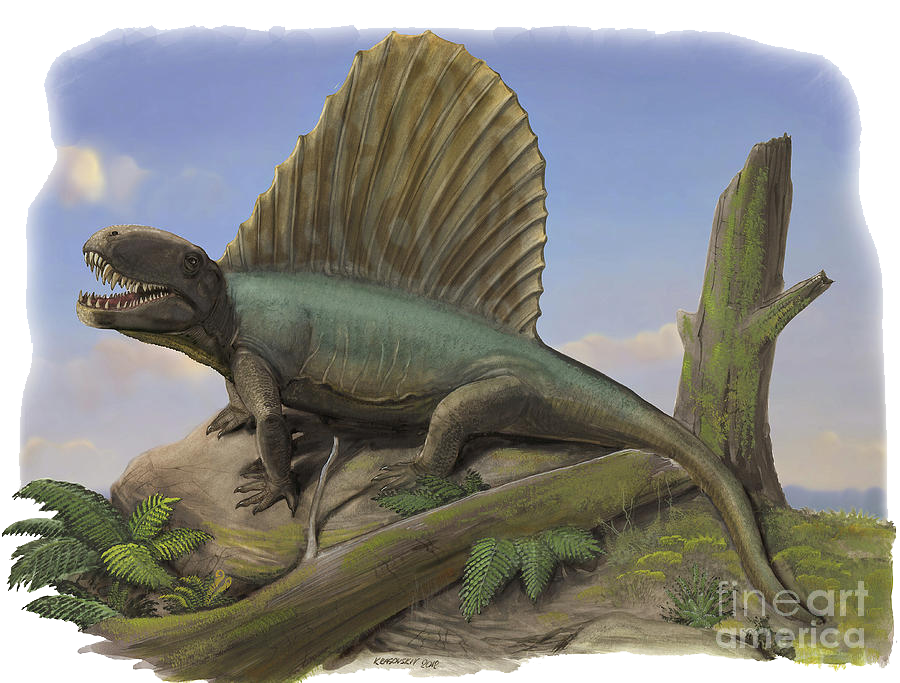
Dimetrodon is one of the most recognizable prehistoric animals that is mistaken for a dinosaur. It looks like a cross between a lizard and dog and has the teeth to match thus its name which translates to, “Two shapes of Teeth.” Despite the fact that the popular culture mistakes this animal for a member of Dinosauria, it had many features that differentiate it from the dinosaurs including; Semi-Squat legs, a thin sail on its back, and mammalian dentition. All these aspects and more make this a very interesting animal, and one of the most common predators of North America and Europe.

Art and Copyright belongs to Daniel Eskridge
Dimetrodon lived during the period known as the Early Permian, more specifically 295–272 million years ago, in a wide range of the world. Fossils of the animal have been discovered in USA (Texas, Oklahoma, Utah, Arizona, Ohio, New Mexico, and Arizona), recently distinguished in Canada and Europe (Germany). The first instance of this animal’s discovery came about in the 1870s by esteemed Paleontologist, Edward Drinker Cope, after receiving the initial specimens from an area of Texas called the Red Beds. Cope acquired the material from collectors excavating the area, they were Swiss naturalist Jacob Boll, geologist W. F. Cummins, and amateur paleontologist Charles Hazelius Sternberg. Edward Drinker Cope sent his material to the American Museum of Natural History while his rival, Othniel Charles Marsh, sent his Dimetrodon material to the Walker Museum in Chicago (Now annexed to the Field Museum). The list of valid species is long and consists of; D. angelensis, D. borealis, D. booneorum, D. dollovianus, D. giganhomogenes, D. grandis, D. limbatus, D. loomisi, D. macrospondylus, D. milleri, D. natalis, D. occidentalis, and D. teutonis. Michigan Paleontologist, Ermine Cowles Case, completed a study on Dimetrodon in which he named a great many species. He was granted funding from the American Museum of Natural History to conduct this study, searching through the material that Edward Drinker Cope had discovered and labeled Dimetrodon. Case found that many of these finds were of new species. After Case’s study, new specimens of Dimetrodon were discovered in other localities of the United States including Utah, Arizona, and Ohio. The latest discovery was in 2001, when a new species of Dimetrodon had been uncovered from the Thuringian Forest of Germany. This new find extended the range of the Permian predator farther than had ever been known. But this pays no homage to the raw power that Dimetrodon housed.


The conglomeration of Dimetrodon Species

Art and Copyright belongs to Dmitry Bogdanov
D. milleri
Art and Copyright belongs to Dmitry Bogdanov
D. natalis
Art and Copyright belongs to Dmitry Bogdanov
D. grandis
Art and Copyright belongs to Conor Daly
D. teutonis
Art and Copyright belongs to Dmitry Bogdanov
D. giganhomegenes
Art and Copyright belongs to Dmitry Bogdanov
D. loomisi
Art and Copyright belongs to Dmitry Bogdanov
D. angelensis
Art and Copyright belongs to Dmitry Bogdanov
D. borealis
Art and Copyright belongs to Atrox1 on DeviantArt
D. limbatus

Art and Copyright belongs to 
D. Grandis (Showing the correct placement of the skin across the spine)


Although Dimetrodon remains a very unusual animal, it loses its uniqueness when compared with the other animals it shared its environment with; Diplocaulus, Eryops, Ophiacodon, Edaphosaurus, Xenacanthus, Diadectes, and many more. Since Dimetrodon would have lived in a very swampy biome, it would likely have preyed upon amphibians and fish of the lakes and streams of its environment. Theories have been proposed by Paleontologists, Robert Bakker and Everett Olson, that Dimetrodon would have been an expert hunter of these aquatic prey and may have been the reason the odd amphibian Diplocaulus evolved its boomerang-shaped headgear; in order to make it difficult for a predator such as Dimetrodon to swallow it whole.

Art and Copyright belongs to Geocities (These are the contemporaries of Dimetrodon)

The anatomy of Dimetrodon is rather odd as well, it showcases adaptations similar to both mammals and reptiles. The skull of Dimetrodon is deep and compressed laterally. The skull has only one pair of holes, called fenestrae, on either side of the skull which is a telltale sign of the animal’s heritage; Dimetrodon was a Synapsid, an early mammal-like-reptile and ancestor to modern mammals. Dimetrodon’s relatives consist of; Sphenacodon, Secodontosaurus, and Cryptovenator. Dimetrodon was also the ancestor of therapsids, another line of Mammal-like-reptiles that eventually led to modern mammals. Dimetrodon teeth were another sign of its relation to mammals; unlike most reptiles and amphibians it shared its environment with, Dimetrodon’s teeth changed shape along the jawline. Canine and incisor teeth were at the front of the jaws, and then smaller teeth lined the rest of the jaw becoming smaller in size. All of the teeth of Dimetrodon are serrated and would have helped hold on to and slice through struggling prey.

Dimetrodon Skeletons, Note: The teeth

One of the most obvious traits that Dimetrodon had is its enormous sail. Along the vertebrae of the animal, a line of tall and thin neural spines juts upwards. It is unknown whether or not the animal truly had a span of skin covering the sail; however this is a very likely hypothesis and has been in use for as long as Dimetrodon has been known to science. The spines are compressed in a rectangular shape from the sides and on many specimens, preserve a figure-eight shape in cross-section. On many specimens, the spines stop at a certain point and start  to point in odd directions. This coupled with the fact that the points of the spine near their end bend sharply, suggests that the sail of skin would only have reached a certain point and then stopped, shortening the sail to be much smaller than usually portrayed. The exact use of this spine, like the spine of most prehistoric animals, is unknown; however, theories exist for its use. One such theory is that the sail could have helped the animal warm up by facing the sun, or cool down by facing away from it. The other, slightly more excepted theory, is that the sail might have been a sexual display to help attract mates. Perhaps the animal could have fed blood into the sail to change its color and help it attract more mates, but these are theories that may never be tested due to the animal being extinct.

Copyright belongs to BBC: Walking with Prehistoric Monsters
               Despite the fact that Dimetrodon is long extinct, it has stayed in the public’s mind as that “other dinosaur.” Commonly portrayed in books about dinosaurs, the common misconception is that this ancient animal is a Dinosaur, of which it is far from it. In fact, Dimetrodon has more in common with humans than it does with Dinosaurs. However, as 99% of all other life forms that have ever existed, it is extinct and the only evidence of it having ever existed is in its fossilized remains. Dimetrodon remains; A strange animal, from an even stranger time.


Works Cited:

"Dimetrodon." Wikipedia. Wikimedia Foundation, n.d. Web. 09 Dec. 2015. <https://en.wikipedia.org/wiki/Dimetrodon>.

"Dimetrodon - Enchanted Learning Software." Dimetrodon - Enchanted Learning Software. Enchanted Learning, n.d. Web. 09 Dec. 2015. <http://www.enchantedlearning.com/subjects/dinosaurs/dinos/Dimetrodon.shtml>.

"How Much Do You Know About Dimetrodon?" About.com Education. About, n.d. Web. 09 Dec. 2015. <http://dinosaurs.about.com/od/typesofdinosaurs/ss/10-Facts-About-Dimetrodon.htm>.

"Dimetrodon." Dinopedia. Wikipedia, n.d. Web. 09 Dec. 2015. <http://dinopedia.wikia.com/wiki/Dimetrodon>.

Gonzalez, Robbie. "All Together Now: DIMETRODON IS NOT A DINOSAUR." Io9. Io9, n.d. Web. 09 Dec. 2015. <http://io9.com/all-together-now-dimetrodon-is-not-a-dinosaur-1580344011>.

Switek, Brian. "Sail-Backed Dimetrodon Had a Nasty Bite." Phenomena SailBacked Dimetrodon Had a Nasty Bite Comments. National Geographic, 07 Feb. 2014. Web. 09 Dec. 2015. <http://phenomena.nationalgeographic.com/2014/02/07/sail-backed-dimetrodon-had-a-nasty-bite/>.

"Canuckosaur! First Canadian 'dinosaur' Becomes Dimetrodon Borealis." ScienceDaily. ScienceDaily, 24 Nov. 2015. Web. 09 Dec. 2015. <http://www.sciencedaily.com/releases/2015/11/151124112849.htm>.