Thursday, January 14, 2016

Media Showcase: Jurassic Park (Dinosaurs)

           
            Easily one of the most recognizable film series of all time, with which it shares its title with other titles like Jaws, Star Wars, and Terminator, Jurassic Park continues to inspire the wonder that Dinosaurs and other prehistoric animals brings to the minds of humans and the silver screen. Jurassic Park was originally written as a novel by well-known author, Michael Crichton, in 1990 and told the story of the foolishness in recreating animals that have been extinct for millions of years without taking the proper precautions. The original Jurassic Park was directed by the esteemed, Steven Spielberg, and was released in 1993. Just going on the title, you can probably guess what the movie is about, dinosaurs! To be more precise, the film and pretty much all of its sequels follows the folly of man in the creation of living breathing members of Dinosauria through the art and magic of genetic cloning (We will disregard the statistical impossibility of this feat, and perhaps leave it for another episode). The first film follows the disaster of a hurricane that wrecks the power of the park, letting the animals go. The main characters, Dr. Grant, Dr. Sully, Ian Malcolm, John Hammond, and his grandkids survive the incident and escape. On this episode of Palo Media Showcase we will take a look at the inaccuracies and inconsistencies of the animals showcased in not just the first film, but the three sequels it has spawned: Jurassic Park: The Lost World, Jurassic Park three, and Jurassic World. We will be going down the list of dinosaurs alphabetically and then analyzing each one to clear up any misconceptions you might have!

Number one: Ankylosaurus


This should show the Ankylosaurus Scene

               Ankylosaurus was only shown in Jurassic Park 3. It can be seen moving through the forest and moving towards a watering hole both in transitional scenes. The way this animal is presented is rather accurate. However, there are still inaccuracies. One thing wrong here would likely be the thickness of the animal. The proportions are a tad off. The real animal would have been extremely wide, rather like a turtle. Another would be the animal’s armor. Throughout most of the 1900s Ankylosaurus was portrayed with spiky armor along its back like that of a porcupine, but this is incorrect. Ankylosaurus would have had very round and flat bony armor embedded in its skin.

Part 2 will come next

Tuesday, January 12, 2016

Paleo File: Bistahieversor

  • Pronunciation: (Bis-Tah-Hee-Ever-Sore)
  • Meaning: "Bistahi Destroyer"
  • Length: 30ft
  • Height: 10ft
  • Weight: 1 ton
  • Diet: Carnivorous
  • Time: 74 MYA
  • Region: North America (New Mexico)

Art and Copyright belongs to Robert; SADistiknight on DeviantArt

Bistahieversor, which translates to “Bistahi Destroyer”, comes from the Kirtland Formation of New Mexico. It represents an unusual stage in the evolution of Tyrannosaurs, due to the shape of its head, whole above its eye socket, and slim, yet strong build.
Original Skull Material (Public Domain)
Reconstructed Skull (Public Domain)


Originally found in 1990, the name Bistahieversor never existed in its place existed Aublysodon. However, more material uncovered in 1992, including a partial skeleton and skull, revealed more of the animal’s anatomy enough to differentiate it from the genus Aublysodon. Then, again more material was uncovered in the Bisti wilderness of New Mexico in 1998 to further differentiate it from its initial genus. It was not until 2010 that the animal was renamed Bistahieversor.

Bistahieversor Reconstruction (Art and Copyright belongs to KindEdmarka on DeviantArt)

Bistahieversor contained features of more advanced Tyrannosaurs as well as more derived genus. Its skull was unusually deep in contrast to Tyrannosaurs that appeared later than it and after it, which suggests that the deepness of the skull is not a feature that evolved in advancement of the family but rather a characteristic that evolved due to environmental pressures. Bistahieversor has been placed in the subfamily Tyrannosaurinae, which consists of; Daspletosaurus, Teratophoneus, Lythronax, and Nanuqsaurus. The material is from both adolescent and adult individuals and as such, the growth stage can be roughly inferred, which is different from many other Tyrannosaur genus. The skull holds a whole above the eye socket found only in the adult skulls and was absent in the juvenile skull, which suggests that it only appeared in adulthood. It is thought that the whole would have held an air sac in life to reduce the skull’s weight. Bistahieversor measured an approximate 30 feet long and 10 feet tall, which reached the similar sizes of Daspletosaurus.


(Art and Copyright belongs to Raul Linia)
This find has elucidated a new predator of the southern hemisphere that had not been previously known, and represents a new spot in the ecosystem. Only more finds will help outline the animal’s hunting habits and perhaps give more insight into how the animal lived.

(Art and Copyright belongs to PrehistoricWildlife)
Works Cited:


"Bistahieversor." Bistahieversor. Prehistoricwildlife, n.d. Web. 12 Jan. 2016. 

"Bistahieversor." Wikipedia. Wikimedia Foundation, n.d. Web. 12 Jan. 2016.

Rettner, Rachael. "New Tyrannosaur Species Discovered." LiveScience. TechMedia Network, 28 Jan. 2010. Web. 12 Jan. 2016.

Tuesday, December 29, 2015

Paleo File: Alioramus

  • Pronunciation: (Ah-Lee-Oh-Ram-Us)
  • Meaning: "Different Branch"
  • Length: 19ft
  • Height: 6ft
  • Diet: Carnivorous
  • Time: Cretaceous (75 MYA)
  • Region: Asia (Mongolia)

Alioramus, a midsized tyrannosaur from the Late Cretaceous (72-66MYA) of Mongolia, is yet another dinosaur grounded in mystery due to scant remains. However, even though this is the case, many details about the animal can be extrapolated from the few remains that have been uncovered.

Alioramus Skull Reconstruction

         A Soviet-Mongolian expedition to the Gobi Desert of Mongolia in the early 1970s uncovered the remains of Alioramus, but it was not until 1976 that soviet paleontologist, Sergei Kurzanov, identified the remains. Kurzanov found the animal to be a tyrannosaur and named it Alioramus remotus, which translates to “Removed Other Branch”. Kurzanov named his find after the fact that the animal contained characteristics of no other animal of the family it belonged to. Kurzanov placed the animal in the general superfamily Tyrannosauroidea. Alioramus remained a very partial species with only fragmentary skull material having been found, until another much more complete find was discovered in 2001 by Julia Clarke on another expedition to Mongolia with the American Museum of Natural History and Mongolian Academy of Sciences. This new species was named Altai, in homage to the Altai Mountains in Mongolia in 2009. This new find consisted of a nearly complete skull, missing just a few minor bones, a complete neck, large segments of the back, sacrum, tail, a nearly complete pelvis, and most of the hind limbs. Although still rather fragmentary, the animal can now be rather accurately reconstructed with a proper body.
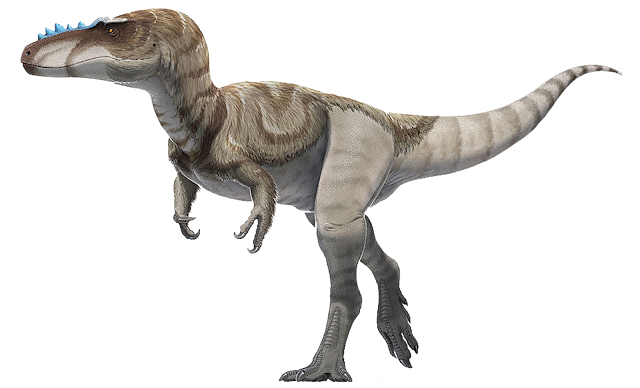
Alioramus Reconstruction (Art and Copyright belongs to Fred Wierum; FredtheDinosaurman on DeviantArt)

          What is known of Alioramus is scant, but what is known is rather interesting. Alioramus is known only from juvenile specimens, and as such, the adult size cannot be fully determined. However, the juvenile specimens uncovered suggest an length of approximately 15-19ft; juvenile Alioramus would have stood as tall as an adult human. The most distinguishing features of Alioramus is its skull. The animal had a very gracile skull much more elongate than the majority of other known Tyrannosaurs (minus Nanotyrannus), not only this, but the skull sported a series of about 5-6 small hornlets that ran along the snout and jutted upwards about 1-2 inches. Due to the fact that the remains only represent juvenile specimens, scientists had hypothesized that Alioramus might be the juvenile of the larger tyrannosaur that it shared its environment with; Tarbosaurus. However, juvenile specimens identified to belong to the genus Tarbosaurus with differing characteristics to Alioramus suggest that the animal was a different species altogether. Slender features and legs like that of an Ornithomimosaur, suggests that Alioramus would have preyed upon smaller animals in comparison to the much larger and more robust Tarbosaurus.

Alioramus Reconstruction with scale (Art and Copyright belongs to Robinson Kunz; Teratophoneus on DeviantArt)

           Speaking of phylogeny, Alioramus has been placed under its own subfamily, Alioramini, which lies inside the family Tyrannosaurinae. Tyrannosaurinae consists of the later tyrannosaurs that shared the characteristics of a atrophied arms, large skulls, and slender legs. Alioramini’s only other member is the recently discovered Qianzhousaurus. Alioramus is related to the other, more well known, tyrannosaurs like; Albertosaurus, Daspletosaurus, Tarbosaurus, and Tyrannosaurus. The 2001 Alioramus finds found that, although the animal had a thin snout usually characteristic of more basal (primitive) forms, it was more related to the large robust forms seen living in close historical proximity to it; I.E. Tyrannosaurus.


            Mongolia, the region of which Alioramus called home, is home to a vast array of other animals that we know a lot about due to over 30 years of research and discovery in the region. Tarbosaurus, Deinocheirus, Gallimimus, Therizinosaurus, Homalocephale, and Nemegtosaurus all shared the ecosystem with Alioramus.


Works Cited:

"Alioramus." Wikipedia. Wikimedia Foundation, n.d. Web. 30 Dec. 2015. <https://en.wikipedia.org/wiki/Alioramus>.

Switek, Brian. "Alioramus Altai: A New, Multi-Horned Tyrant." Smithsonian. Smithsonian, 6 Oct. 2009. Web. 30 Dec. 2015. <http://www.smithsonianmag.com/science-nature/alioramus-altai-a-new-multi-horned-tyrant-54512057/?no-ist>.

Murray, Melissa. "Australian Museum." Alioramus Altai -. Australian Museum, 20 Nov. 2013. Web. 30 Dec. 2015. <http://australianmuseum.net.au/alioramus-altai>.

Hone, Dave. "Guest Post: A New Tyrannosaur - Alioramus Altai." Dave Hones Archosaur Musings. Word Press, 05 Oct. 2009. Web. 30 Dec. 2015. <https://archosaurmusings.wordpress.com/2009/10/06/guest-post-a-new-tyrannosaur-alioramus-altai/>.

Thursday, December 24, 2015

Paleo Files: Albertosaurus

  • Pronunciation: (Al-Burt-Oh-Sore-Us)
  • Name Meaning: "Alberta Lizard"
  • Height: 9ft
  • Weight: up to 2.5 tons
  • Length: 26-29ft
  • Diet: Carnivorous
  • Time: Cretaceous (70 MYA)
  • Region: North America (Canada)
Albertosaurus Bust (Art and Copyright belongs to Heraldo; BrokenMachine86 on DeviantArt)

Albertosaurus, the top predator of late cretaceous Canada, is one of the most well known theropods among the vast majority of fragmentary ones. Albertosaurus got its name from the province of Canada in which it was discovered. The top predator of its region, the “Alberta Lizard” would have had no other predators big enough to complete for resources with in the northern parts of North America. Albertosaurus shows a wonderful example in the line of Tyrannosaur evolution showing a transition from a lithe and streamlined form into that of a more heavily built predator like Daspletosaurus and eventually Tyrannosaurus.

Albertosaurus with Feathery Coat (Note: Albertosaurus lived so far north, even in the cretaceous, that it may have seen snow)
(Art and Copyright belongs to StygimolochSpinifer on DeviantArt)

The type specimen of Albertosaurus consists of a partial skull. This specimen came from the Horseshoe Canyon Formation near the Red Deer River in Alberta, Canada. Paleontologist, Joseph Burr Tyrell, uncovered the type specimen; however, he could only partially secure the find, due to lack of specialized equipment, and only acquired a part of the skull. In 1889 Tyrell’s colleague, Thomas Chesmer Weston, found another specimen, this time being an incomplete skull smaller than the first and located nearby. These two specimens were placed under the species, Laelaps incrassatus, named by Edward Drinker Cope in 1892. The name Laelaps had been previously attributed to a kind of mite and thus made the name a nomen dubium. Othniel Charles Marsh, Cope’s rival, renamed the genus Dryptosaurus in 1877. Edward Drinker Cope refused to acknowledge his rival’s decision and continued to use Laelaps as a legitimate name. Many remains were uncovered after the fact, going unnamed until Henry Fairfield Osborn, a well-known American Paleontologist, coined the name Albertosaurus in 1905 when he wrote his description of the much larger, Tyrannosaurus. Later on, in the year 1910, famed paleontologist, Barnum Brown, uncovered the remains of a mass of Albertosaurus near the Red Deer River. Due to the large amount of individuals, Brown and his expedition were unable to collect all of the specimens. They took the important identifying fossils, which told them that at the site lay at least nine individuals. All in all, 1,128 Albertosaurus fossils had been uncovered from the bone-bed; the largest concentration of Theropod fossils ever found in Cretaceous sediments, which is why so much is known about this animal’s biology.


Albertosaurus Skeleton
Due to the large amounts of sizes and ages of the individuals discovered near the Red Deer River, the ontogenetic cycles of growth for Albertosaurus is relatively well known. Remains Approximately two years of age, measuring six feet long and weighing no less than one hundred and ten pounds showcased the youngest individual. The eldest specimen found consisted of a length of thirty-three feet and might have been twenty-eight years of age at the time of death. The growth and death rates of the bone-yard in the Red Deer River compared with the other Albertosaurus finds suggest that the animal grew at an exceedingly fast rate along a four-year period that ended at approximately age sixteen which began the onset of sexual maturity. This growth is unlike most Avians and is more akin to the growth rates of large mammals. These statistics also revealed a hypothesis concerning the mortality rate. The theory suggests that the hatchlings had a rather high mortality rate, explaining why fossils of young individuals have not been commonly discovered. Then, after two years of growth, the animals would have been much larger than many of the predators it shared its ecosystem with and the death mortality decreased sharply. However, the mortality rate again increased, doubling at around the age of twelve and then doubling again around the age of sexual maturity. The find of dozens of specimens in the bone-bed of the Red Deer River might suggest that the animals hunted together in packs. This theory has been suggested for many theropods found together. But the opposing theory to this is that they may have been killed due to environmental reasons and then deposited together after death. Canadian Paleontologist, Philip J. Currie, suggests that the legs of the younger Albertosaurus might have helped them draw the prey towards the adults that were slower and more powerful. Currie speculates that the young Albertosaurus, having different adaptations compared with the adults, may have had a different way of life similar to the Komodo Dragon of the present (young live the lives of insectivores, while adults are the largest predators on their island, attacking and killing water buffalo). Due to the fact that behavior does not fossilize, Currie’s theory is speculation and cannot be tested. However, what can be observed is what it lived with and what it may have hunted.

Contemporaries of Albertosaurus (Art and Copyright belongs to Geocities)
All of the Albertosaurus material is known from Canada, most of which is from the Horseshoe Canyon Formation housing fossils from the Maastrichtian age of the Cretaceous period. Other species found in and around this area and time include; Didelphodon, Champsosaurus, Saurolophus, Hypacrosaurus, Albertonykus, Pachyrhinosaurus, Ornithomimus, Stegoceras, and many more. Albertosaurus would have been the top predator of this ecosystem and might have preyed on most of these animals. However, Pachyrhinosaurus grew to be one of the largest Ceratopsians dinosaurs in existence and would have given even an adult Albertosaurus trouble (potentially evidence for pack behavior). Albertosaurus may have lived with its cousins Gorgosaurus and Daspletosaurus. Albertosaurus is placed inside the subfamily, Albertosaurinae, the only other member being Gorgosaurus. This subfamily showcases animals of a slim build and capable of quick movements unlike their descendants which include; Daspletosaurus, Teratophoneus, Bistahieversor, Tyrannosaurus, and Tarbosaurus.


This predator may have been at the top of the food chain, but environmental disasters have no bias and kill without mercy. Whether Albertosaurus fell prey to the elements, or each other, they all ended up in the same place. To be uncovered by our species many of millions of years later. We learn from these fossils of how the earth was at a previous time to help us understand the earth as it is today.

Art and Copyright belongs to Prehistoric Wildlife

Works Cited:

"Albertosaurus." Wikipedia. Wikimedia Foundation, n.d. Web. 24 Dec. 2015. <https://en.wikipedia.org/wiki/Albertosaurus>.

"Albertosaurus- Enchanted Learning Software." Albertosaurus- Enchanted Learning Software. Enchanted Learning, n.d. Web. 24 Dec. 2015. <http://www.enchantedlearning.com/subjects/dinosaurs/dinos/Albertosaurus.shtml>.

"Albertosaurus." Dinopedia. Wikipedia, n.d. Web. 24 Dec. 2015. <http://dinopedia.wikia.com/wiki/Albertosaurus>.

"Albertosaurus." HowStuffWorks. HowStuffWorks, 19 Mar. 2008. Web. 24 Dec. 2015. <http://animals.howstuffworks.com/dinosaurs/albertosaurus.htm>.

"Albertosaurus Libratus - a Tyrannosaur Dinosaur from the Late Cretaceous." Albertosaurus Libratus - a Tyrannosaur Dinosaur from the Late Cretaceous. Feenixx, n.d. Web. 24 Dec. 2015. <http://www.dinosaur-world.com/tyrannosaurs/albertosaurus_sarcophagus-include.htm>.

"Albertosaurus." Albertosaurus. Prehistoric Wildlife, n.d. Web. 24 Dec. 2015. <http://www.prehistoric-wildlife.com/species/a/albertosaurus.html>.

"Albertosaurus Cretaceous Dinosaur." Albertosaurus Dinosaur. Fossil Museum, n.d. Web. 24 Dec. 2015. <http://www.fossilmuseum.net/DinosaurFossils/Albertosaurus/albertosaurus.htm>.

"The Dino Directory - Albertosaurus - Natural History Museum." The Dino Directory - Albertosaurus - Natural History Museum. Natural History Museum, n.d. Web. 24 Dec. 2015. <http://www.nhm.ac.uk/discover/dino-directory/albertosaurus.html>.

"Australian Museum." Albertosaurus Sarcophagus -. Australian Museum, n.d. Web. 24 Dec. 2015. <http://australianmuseum.net.au/albertosaurus-sarcophagus>.